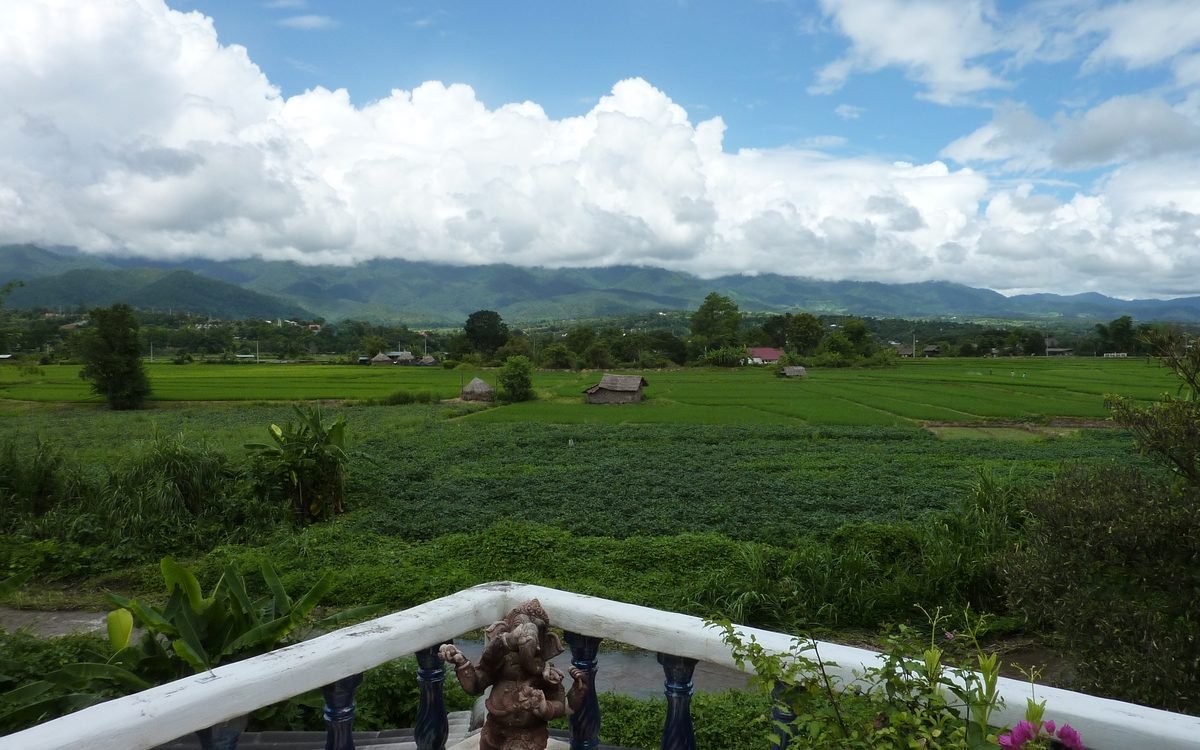
The best things to do in Pai are sunset at Pai Canyon, a soak in the Tha Pai hot springs, swimming at Mo Paeng and Pam Bok waterfalls, walking the Boon Ko Ku So bamboo bridge over the rice fields, sunrise at Yun Lai viewpoint and the nightly Walking Street. Add a day trip to Tham Lod cave and allow 3-4 days.
Pai is a small town in a wide green valley in Mae Hong Son province, about 135 km north-west of Chiang Mai. It started as a quiet market town for the surrounding Shan, Lisu, Lahu and Karen villages, became a backpacker hideaway in the 1990s and is now one of northern Thailand's favourite escapes, with guesthouses, cafes and yoga retreats scattered through the rice fields.
The town centre is tiny and walkable, but most of what makes Pai special lies a few kilometres out: canyons, waterfalls, hot springs, viewpoints and hill villages. That means you will want your own wheels or a driver. Three to four days is the sweet spot; many people end up staying much longer.
Timing changes Pai completely. November to February brings cool, clear days and misty mornings, with nights that can drop to around 10-12°C, so pack a warm layer. March and April is the burning season, when smoke from field and forest fires often makes the air unhealthy and hides the views. June to October is green and lush, with rice fields at their best from August, but expect rain and slippery roads. See the best time to visit Thailand.
Pai Canyon (Kong Lan) is about 8 km south of town on the road to Chiang Mai. It is a set of narrow, eroded sandstone ridges with steep drops on both sides, looking out over forest and the valley. Entry is free, and a short staircase from the car park takes you to the first viewpoint.
The ridges are fun to explore but genuinely exposed: paths are often only a metre wide, the red earth is loose and there are no railings. Wear shoes with grip rather than flip-flops, keep away from the edges after rain and do not let the golden-hour crowd rush you. Sunset is the main event, so arrive by around 5pm to find a spot; for fewer people, come in the early morning instead.
After a day on a scooter, nothing beats a soak. Pai has two main hot springs:
The waterfalls are free and best between July and December when they have plenty of water:
Combine Mo Paeng with Santichon village and Yun Lai viewpoint, which are on the same side of the valley.
The Boon Ko Ku So bamboo bridge is a walkway of woven bamboo, around 800 metres long, that zigzags across the paddy fields to a small forest temple, Wat Tham Pa Phu Kon. It was built so that monks from the temple could walk to the village for their morning alms. The setting is lovely, with mountains on every side, and it is at its most photogenic when the rice is green from about August to October, or golden just before the harvest.
The bridge is around 10 km from town; there is a small donation or entry fee of roughly 20-30 THB. Remember that it leads to a working temple: keep shoulders and knees covered and keep your voice down. Our guide to temple etiquette in Thailand covers the essentials.
Pai's hills give you a new view at every turn. The best-known spots:
The hills are also dotted with viewpoint cafes looking over the valley. Order a local coffee; the beans grown in the Mae Hong Son highlands are excellent.
The best day trip from Pai is Tham Lod (Lod Cave), about 50 km north-west near the village of Soppong. A river flows right through this huge limestone cave. Local guides from the village lead you through its three chambers by gas lantern, and part of the route is done on a bamboo raft. Inside are stalactites, old wooden coffins and ancient pottery.
Expect to pay for a guide per small group plus a separate charge for the raft, roughly 450-900 THB in total for a couple, depending on water level and group size. The big moment comes at dusk, when hundreds of thousands of swifts return to the cave at the exit chamber while bats stream out; aim to finish your visit around 5-6pm to see it.
The road from Pai to Soppong climbs through pine forest and several viewpoints. From there you can continue to Mae Hong Son on the classic northern loop.
Every evening from about 5pm until late, Pai's main streets close to traffic and become the Walking Street: food stalls, handmade jewellery, hill-tribe textiles and buskers. It is the best place to graze on cheap food, from khao soi and Shan-style noodles to grilled skewers and mango sticky rice, at around 40-100 THB per dish.
Nightlife is relaxed: live-music bars, a few late spots along the river and campfire gatherings at hostels. Read our food in Thailand guide for what to try up north.
Pai is a good base for gentle adventure:
You will see signs for elephant camps near Pai. We do not recommend riding or bathing elephants; if you want to see them, choose a genuine observation-only sanctuary, as explained in our ethical elephant sanctuary guide.
Pai lies at the end of a mountain road from Chiang Mai famous for its roughly 760 curves. Minivans leave Chiang Mai's Arcade bus station and several town-centre offices throughout the day: about 3-3.5 hours and 150-250 THB. If you get car sick, take a travel-sickness tablet, sit near the front and avoid a heavy breakfast. A private car costs around 2,000-3,000 THB. Book your seat through our transport tickets page, especially in high season.
In town you can walk, but for the sights you need transport:
With an extra day, add a trek or a lazy cafe day in the rice fields. For places to stay, look in the centre for convenience or across the river for quiet bungalows, and compare hotels in Pai. If you are fitting Pai into a longer route, our Chiang Mai guide helps plan the days either side.
Three to four days lets you see the canyon, hot springs, waterfalls, bamboo bridge and Tham Lod without rushing. Many travellers stay a week or more to slow down.
Take a minivan from Chiang Mai, about 3-3.5 hours and 150-250 THB, on a winding mountain road with around 760 curves. A private car costs roughly 2,000-3,000 THB.
November to February is best, with cool, clear weather and misty mornings. Avoid March and April if you can, when smoke from burning often ruins the air quality and views.
Not strictly. The town is walkable, and shared tours or hired drivers cover the main sights. Only rent a scooter if you are an experienced, licensed rider, as the hill roads are steep and accidents are common.
Yes, entry to Pai Canyon is free. The ridges have no railings and crumbly edges, so wear shoes with grip and take care, especially after rain.