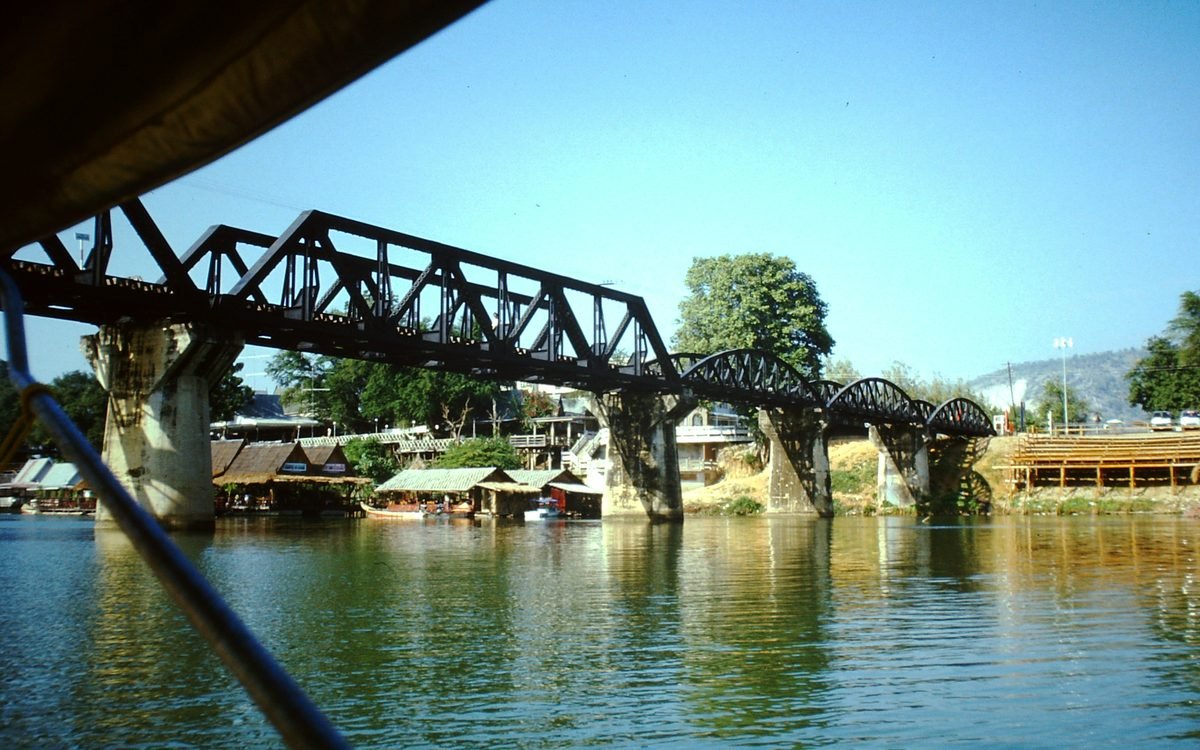
The best things to do in Kanchanaburi are walking the Bridge over the River Kwai, riding the Death Railway across the Tham Krasae viaduct, visiting Hellfire Pass and the war cemeteries, and swimming in the seven tiers of Erawan Falls. Two to three nights is enough to see the history and the national parks without rushing.
Kanchanaburi sits about 130 km west of Bangkok, where the Khwae Noi and Khwae Yai rivers meet in a valley of limestone hills. It combines two things you rarely find in one place: some of the most moving Second World War history in Asia, and a green, relaxed countryside of waterfalls, caves and floating raft houses. Most visitors come on a rushed day tour from Bangkok. Staying two or three nights is far better, because the best sights are spread out and the evenings by the river are half the charm.
The town itself is small. The main backpacker strip is Maenam Kwai Road, lined with guesthouses, cafes and bars, while the famous bridge sits about 3 km north of the centre. For background on the region and nearby parks, see our Kanchanaburi destination guide.
Each year in late November to early December the River Kwai Bridge Festival brings a light and sound show re-enacting the bombing of the bridge. It is loud and popular with Thai visitors; book accommodation early if your dates overlap.
The best single experience in Kanchanaburi is riding the surviving section of the Death Railway. Ordinary third-class trains run from Kanchanaburi station across the bridge and on to Nam Tok, taking around two and a half hours. Foreigners pay a flat fare of 100 THB, whether you board in Bangkok or in Kanchanaburi.
About 80 km north-west of town, Hellfire Pass (Konyu Cutting) is where prisoners hacked a railway cutting through solid rock by hand, working through the night by torchlight in 1943. The Hellfire Pass Interpretive Centre, run with the Australian government, is outstanding: a well-designed museum followed by a walking trail down into the cutting itself and along the old railway bed.
If you only have time for one history site outside town, make it this one.
Erawan National Park, about 65 km from town, is home to Thailand's most famous waterfall: seven tiers of turquoise pools stepping down through the forest. Foreigners pay 300 THB park entry (about 8 euros). The park opens at 8:00 and the upper tiers typically close from around 15:00, so arrive early. Our Erawan National Park guide covers the trail in detail.
Other parks worth a look: Sai Yok National Park, with bat caves and forest trails, and Si Nakharin National Park with its Huai Mae Khamin falls, which many rate above Erawan for fewer crowds. Both are best by private driver.
Skip the former 'Tiger Temple' and any venue offering elephant rides, bathing shows or animal photo sessions. If you want to see elephants, read our ethical elephant sanctuary guide first. Dress modestly at every temple; cover shoulders and knees and remove shoes before entering halls.
Kanchanaburi is at its best by the water. A night or two in a floating raft house on the River Kwai, either in town or further upstream towards Sai Yok, is one of the most memorable stays in western Thailand. Rooms range from basic bamboo huts at 500-900 THB to comfortable resorts at 2,500-6,000 THB. Compare options on our Kanchanaburi hotels page.
If you have an extra two days, continue about 220 km north to Sangkhlaburi, a quiet town on a reservoir near the Myanmar border. Its wooden Mon Bridge links the Thai side with the Mon village, and the submerged 'sunken temple' appears when water levels drop in the dry season. The drive, past Hellfire Pass and through forested hills, is one of the best in the region. Buses and minivans take around four to five hours from Kanchanaburi.
| Option | Time | Cost | Notes |
|---|---|---|---|
| Train from Bangkok Thonburi station | about 3 hours | 100 THB | Two departures a day, scenic and slow |
| Minivan or bus from Bangkok (Southern Bus Terminal or Mo Chit) | 2-3 hours | 120-200 THB | Frequent through the day |
| Private car or taxi from Bangkok | 2-2.5 hours | 2,000-3,000 THB | Door to door, can stop at sights |
Book buses and trains through our transport tickets page. In town, songthaews and tuk-tuks cost 50-100 THB for short hops; for Erawan and Hellfire Pass in one day, a private driver costs roughly 1,800-2,500 THB.
How long? Two nights covers the bridge, museums, the train and Erawan. Three nights adds Hellfire Pass and a slow raft-house day. Kanchanaburi also fits neatly into longer routes; see our 3-week Thailand itinerary. The cool season from November to February is the most comfortable, while the waterfalls are fullest from August to November.
Yes. It combines essential Second World War history, including the River Kwai Bridge and Hellfire Pass, with waterfalls, caves and raft houses. It is far more rewarding as an overnight stay than a rushed day trip from Bangkok.
You can see the bridge, the war cemetery and a short train ride on a long day tour, but you will spend five or more hours on the road. Two nights lets you add Erawan Falls and Hellfire Pass at a sensible pace.
Foreigners pay a flat 100 THB for the ordinary train between Bangkok, Kanchanaburi and Nam Tok. Special weekend tourist trains cost more.
Foreign adults pay 300 THB to enter Erawan National Park, and the upper tiers close from mid-afternoon, so arrive in the morning.
Local buses leave Kanchanaburi bus station roughly every hour from early morning and take about 1.5 hours. Alternatively rent a scooter or hire a driver for around 1,500-2,500 THB for the day.